- English
- French
- German
- Portuguese
- Spanish
- Russian
- Japanese
- Korean
- Arabic
- Greek
- German
- Turkish
- Italian
- Danish
- Romanian
- Indonesian
- Czech
- Afrikaans
- Swedish
- Polish
- Basque
- Catalan
- Esperanto
- Hindi
- Lao
- Albanian
- Amharic
- Armenian
- Azerbaijani
- Belarusian
- Bengali
- Bosnian
- Bulgarian
- Cebuano
- Chichewa
- Corsican
- Croatian
- Dutch
- Estonian
- Filipino
- Finnish
- Frisian
- Galician
- Georgian
- Gujarati
- Haitian
- Hausa
- Hawaiian
- Hebrew
- Hmong
- Hungarian
- Icelandic
- Igbo
- Javanese
- Kannada
- Kazakh
- Khmer
- Kurdish
- Kyrgyz
- Latin
- Latvian
- Lithuanian
- Luxembou..
- Macedonian
- Malagasy
- Malay
- Malayalam
- Maltese
- Maori
- Marathi
- Mongolian
- Burmese
- Nepali
- Norwegian
- Pashto
- Persian
- Punjabi
- Serbian
- Sesotho
- Sinhala
- Slovak
- Slovenian
- Somali
- Samoan
- Scots Gaelic
- Shona
- Sindhi
- Sundanese
- Swahili
- Tajik
- Tamil
- Telugu
- Thai
- Ukrainian
- Urdu
- Uzbek
- Vietnamese
- Welsh
- Xhosa
- Yiddish
- Yoruba
- Zulu
Paint Hangar Design: Key Features for Safe Operations
A safe paint hangar features a structural shell with a clear span, regulated ventilation, filtration, temperature control, and code-based fire protection. The design should have separate zones for preparation, painting, drying, and inspection. Airflow must purge solvent vapors before they reach harmful levels, and electrical and suppression systems must fulfill NFPA and OSHA guidelines. This paper was designed for contractors, EPC teams, and facility owners who need to define or build one. I talk about the basics of design, air systems, fire safety, procurement processes, and what a welded H-section steel structure does.

Core Paint Hangar Design Requirements
What a Paint Hangar Does and Why Design Matters
Paint hangars are enclosed buildings that control the environment inside. They are used for the painting of huge items such as cars, airplanes, wind turbine components, and other large workpieces. You can deal with surface preparation, painting, drying and inspecting, lighting, ventilation, temperature, humidity, and overspray all at the same time. Please notice this is not a storage space. A poor design may lead to problems with completion, provide a fire hazard to workers, contribute to high energy costs, and make the project run late. Before painting, I normally ask what the workpiece is, how big it is, and what kind of coating the team will use. All the other options rely on those answers.
Layout, Clearance, and Interior Materials
Good design should have clear lines between clean, preparing, painting, drying, inspection, and dirty areas. The paths should be laid out so that people can go to work, items can be delivered, and waste can be collected without walking through patches of wet paint. Wings, tails, scaffolds, lifting tools, and servicing platforms all demand space, and therefore clearance becomes more important than floor space. Interior surfaces should be easy to clean and durable enough to withstand moisture and chemicals. The main features are large doors with robust sealing, emergency exits, and even lighting. Constant light may also be used by inspectors to look for defects. All of these aspects work together to provide a clean facility and predictable paint job.
The Steel Structure Behind the Paint Hangar
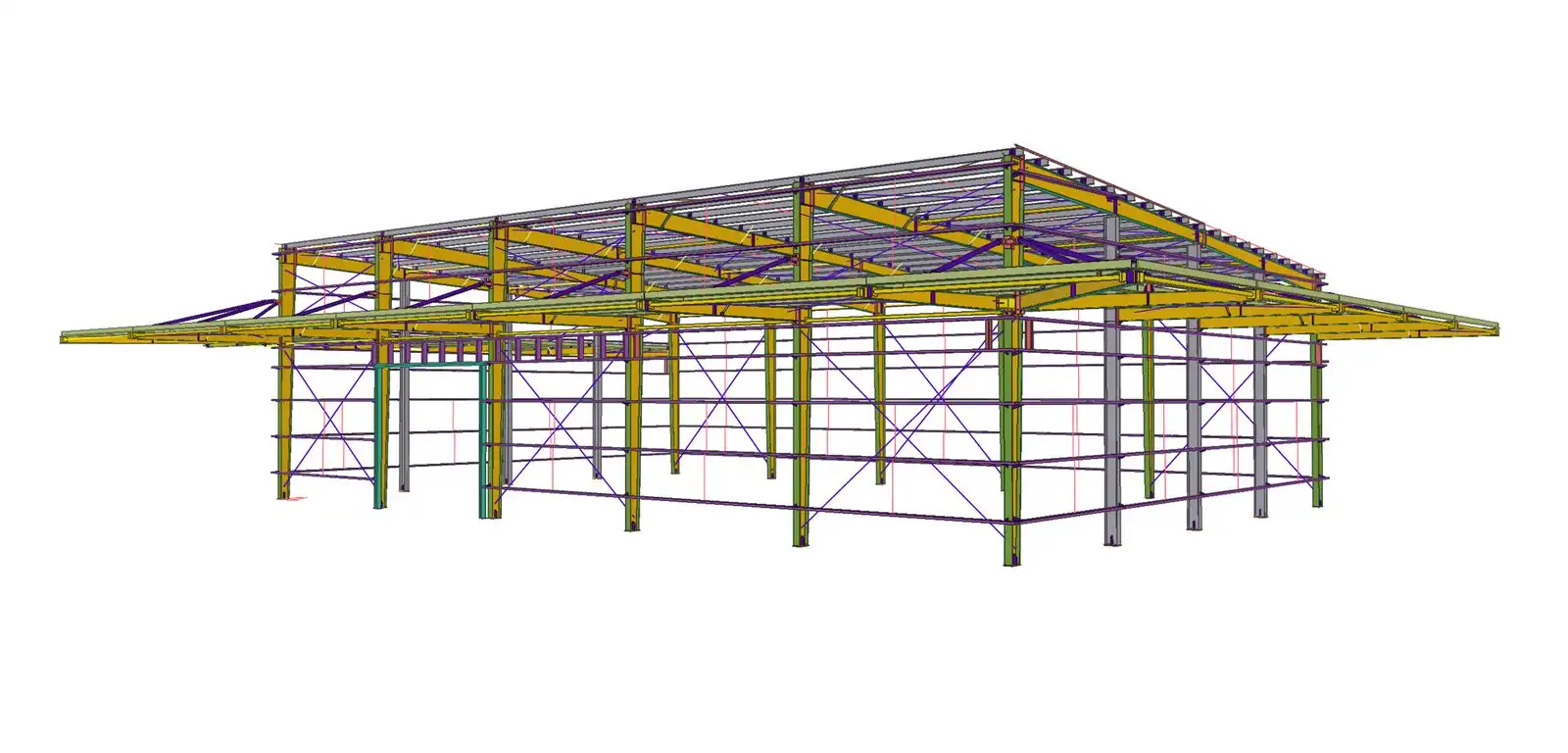
The first is the shell (the place DFX runs). Qingdao Director Steel Structure Co., Ltd. has been a structural steel manufacturer since 2011. The company has a production area of 40,000 square meters and six fully automatic welded H-beam lines. In our steel buildings, the major construction is welded H-sections, and the bracing system is superior and stronger. The wide span also eliminates the need for interior support columns, which benefits aircraft with large wingspans and steep tails. In our service, we also provide structural calculations, exclusive designs, fabrication, and installation assistance. Our products are manufactured under an ISO quality management system and are certified by CE, COC, and PVOC.
Air, Filtration, and Climate Control
Ventilation and Airflow Patterns
Air movement carries paint fumes, solvent vapors, and overspray away. Depending on the size of the aircraft, the coating procedure, and the finish sought, designers pick a pattern – cross-flow, downdraft, semi-downdraft, side-draft, or end-draft. Overspray from the fuselage is eliminated by downdraft but requires deep concrete holes. Cross-flow is OK on existing slabs but care must be taken that the overspray is not running down the aircraft. Many designs need 60 to 100 feet per minute over the work area. NFPA 33 additionally requires ventilation to keep vapor concentrations below 25 percent of the lower flammable limit. Paint hangars need make-up air to compensate for the output volume.
Filtration and Overspray Control
The air is purified before being discharged from the building. Normal stages are pre-filters, paint arrestors, fine particle filters, and activated carbon for certain coatings. “Don’t just look at the purchase price; consider capture efficiency, pressure drop, filter life, disposal processes, and overall operating cost. Differential pressure gauges tell personnel when filters are full and require replacement. At the beginning of the procedure, verify your regulatory status for the EPA area source regulation for paint stripping and miscellaneous surface coatings (40 CFR Part 63, Subpart HHHHHH). Document and keep a routine for inspecting filters, checking seals, handling spent media, and keeping extra stock.
Temperature and Humidity Control
Temperature and humidity may affect paint viscosity, flash-off time, adhesion, cure, gloss, and color. Poor control results in sags, flushes, and other surface defects. The sizing of the heating, cooling, and dehumidification equipment, as well as the hangar capacity, should be based on the local environment, frequency of opening the doors, and the coating producer’s data sheet. Monitor airflow, pressure, temperature, dew point, and filter pressure drop. Central controls include data collection, warnings, and interlocks to maintain stable conditions across seasons and changes. High insulation and tight door seals cut conditioning loads, and a tight shell of steel. So I'd say develop the structural and climatic system at the same time.
Fire Safety and Choosing the Right Facility
Fire Protection and Code Compliance
The planning team should cover fire safety at the first design meeting. Key safeguards include detection and suppression systems, emergency stop stations, grounding and bonding, properly classified electrical equipment, hazardous material storage, exits, and controlled shutdown of ventilation. NFPA 409 Aircraft Hangars; NFPA 33 addresses spray application. NFPA 70 Article 516 concerns electrical installations in spray areas. OSHA guidelines govern worker safety in the US. Ultimately, the final decision is with the local authorities with jurisdiction; thus, I would recommend you get them involved with designs early on. Prior to construction, certified fire protection engineers should coordinate lighting, fans, interlocks, and emergency procedures for the paint hangar.
Paint Hangar vs. Spray Booth
Spray booths are suitable for small objects, with compact airflow control and lower initial cost. Hangars are built to store whole airplanes, helicopters, large vehicles, and large industrial equipment. Compare open-front, enclosed, temporary, modular and permanent layouts by: Confinement Climatic stability Installation time Extension potential Energy use These concerns are seen differently by MRO shops, OEMs, military users and manufacturers. If your largest workpiece only fits in a booth or you want to process larger items in the future, a hangar gives you room to grow.
How to Choose the Right System
Start with the application: workpiece sizes, maximum weight, coating materials, spraying method, throughput, curing requirements, and planned expansions. Then think about airflow uniformity, filtration, temperature control, fire system integration, structural integrity, power consumption, and access for monitoring and maintenance. Evaluate the entire cost of ownership, including engineering, civil works, installation, commissioning, energy, filters, downtime, and compliance updates. A lot of clients seek an integrated product. Then I would ask each supplier just what scope it entails: construction, mechanical systems, controls, or all of them.
Procurement, Installation, and Common Mistakes
Writing a Clear Procurement Specification
Suppliers can provide you with a reliable estimate when you have a precise specification. The size and weight of the workpiece will be crucial in evaluating handling procedures, types of coatings and solvents, spray equipment, finish expectations, throughput, climatic circumstances, utilities, local needs, deadlines, and expansion goals. Ask suppliers about airflow, filtration, humidity management, vapor control, fire protection, commissioning tests, replacement parts, service, and paperwork. Ask for structural calculations and fabrication drawings for the steel shell of the paint hangar so your engineer can review the loads imposed by doors, lifting equipment, and mechanical systems before work starts on the fabrication.
Installation, Commissioning, and Maintenance
From site evaluation to design, production, installation, system integration, commissioning, and operator education. 1. Duties of the supplier, civil contractor, utility suppliers, and owner. Verify structure, doors, ventilation, exhaust discharge, filtration, temperature control, alarms, emergency stops, grounding, and fire system interfaces during commissioning. Then Maintenance inspects filters, fans, ducts, dampers, lights, doors, and interlocks daily, weekly, monthly, quarterly, and annually. DFX provides installation instructions for the steel framework to ensure your crew correctly erects the frame.
Common Design Mistakes to Avoid
The usual faults are choosing the equipment without defining the coating process, capacity, and size of the item. Others underestimate airflow and makeup air, see fire protection as an add-on, buy on initial cost alone, and overlook future expansion. This results in unstable airflow, poor finishes, a lot of energy use, difficult maintenance, and costly code changes. Avoid them by doing a process and capacity evaluation, validating performance via computation and testing, and including safety elements in the design from day one. A longer span frame with more height and length to allow growth.
Conclusion
The correct sequence of options is derived from the safe paint hangar. First define the workpiece, the coating technology, and the capacity. Then design a layout with segregated zones, enough clearances, and cleanable surfaces within a clear-span steel shell. Worker and finish quality protection is provided by ventilation, filtration, and temperature control. Fire protection and electrical classification must conform to NFPA, OSHA, and local requirements. Booth for small products. The hangar is for large aircraft and gear. Clear specifications, defined tasks, commissioning tests, and regular maintenance reduce faults, downtime, and safety incidents.
FAQ
1. What is the main difference between a paint hangar and a standard hangar?
A standard hangar is used for storing and maintaining aircraft. A paint hangar adds controlled ventilation, filtration, climate control, suitably classified electrical equipment, and fire protection specifically for coating work.
2. Can I retrofit a paint hangar into an existing building?
Often, yes. A common method involves placing a self-supporting structure inside the existing shell, provided the foundation and utilities can carry the added loads. A professional engineer should confirm this feasibility first.
3. What does DFX supply for a paint hangar project?
DFX supplies the long-span welded H-section steel structure, including structural calculations, customized design, fabrication, and installation guidance. Specialist engineers handle the air handling, filtration, and fire systems. Final specifications depend on the coatings, local climate, and regional rules.
Request a Paint Hangar Steel Structure Quote from DFX
Ready to plan your project? DFX, Qingdao Director Steel Structure Co., Ltd., has fabricated structural steel since 2011. As a paint hangar steel structure manufacturer, we provide structural calculations, customized design, fabrication, and installation guidance. Email jason@bigdirector.com with your dimensions and location. Our team will reply with a project-specific proposal.
References
1. NFPA 33: Standard for Spray Application Using Flammable or Combustible Materials, 2021
2. NFPA 409: Standard on Aircraft Hangars, 2022
3. NFPA 70: National Electrical Code, 2023
4. ACGIH, Industrial Ventilation: A Manual of Recommended Practice for Design, 2019
5. U.S. Environmental Protection Agency, National Emission Standards for Hazardous Air Pollutants: Paint Stripping and Miscellaneous Surface Coating Operations at Area Sources, 2008
6. AISC, Steel Construction Manual, 2022
Learn about our latest products and discounts through SMS or email