- English
- French
- German
- Portuguese
- Spanish
- Russian
- Japanese
- Korean
- Arabic
- Greek
- German
- Turkish
- Italian
- Danish
- Romanian
- Indonesian
- Czech
- Afrikaans
- Swedish
- Polish
- Basque
- Catalan
- Esperanto
- Hindi
- Lao
- Albanian
- Amharic
- Armenian
- Azerbaijani
- Belarusian
- Bengali
- Bosnian
- Bulgarian
- Cebuano
- Chichewa
- Corsican
- Croatian
- Dutch
- Estonian
- Filipino
- Finnish
- Frisian
- Galician
- Georgian
- Gujarati
- Haitian
- Hausa
- Hawaiian
- Hebrew
- Hmong
- Hungarian
- Icelandic
- Igbo
- Javanese
- Kannada
- Kazakh
- Khmer
- Kurdish
- Kyrgyz
- Latin
- Latvian
- Lithuanian
- Luxembou..
- Macedonian
- Malagasy
- Malay
- Malayalam
- Maltese
- Maori
- Marathi
- Mongolian
- Burmese
- Nepali
- Norwegian
- Pashto
- Persian
- Punjabi
- Serbian
- Sesotho
- Sinhala
- Slovak
- Slovenian
- Somali
- Samoan
- Scots Gaelic
- Shona
- Sindhi
- Sundanese
- Swahili
- Tajik
- Tamil
- Telugu
- Thai
- Ukrainian
- Urdu
- Uzbek
- Vietnamese
- Welsh
- Xhosa
- Yiddish
- Yoruba
- Zulu
Why Choose a Fast Assembly Steel Logistics Warehouse?
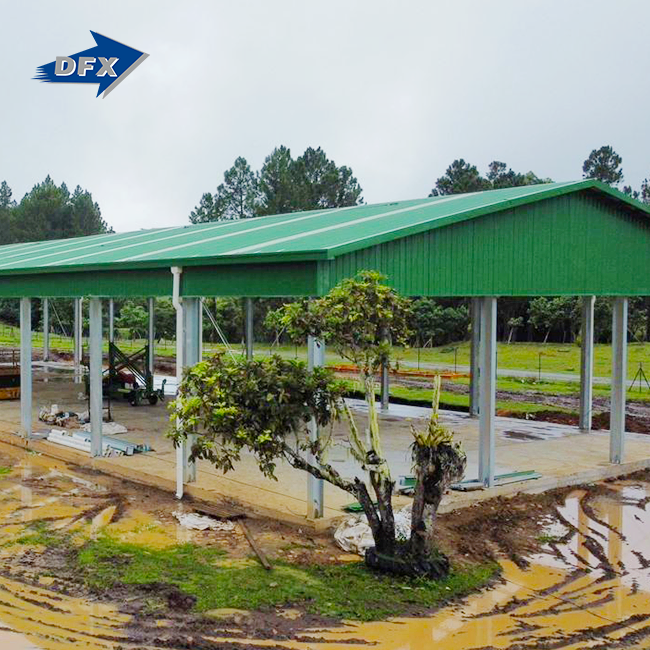
When you need to complete a project quickly and have rigorous operational criteria, a rapid assembly steel logistics fast assembly steel logistics warehouse is the perfect choice. It provides speed, structural dependability, and long-term value. Pre-engineered steel structures give true design freedom, decrease construction timeframes by 30–50%, and reduce the cost of labor on-site, compared to standard concrete buildings. Whether you are in charge of a transportation hub, a storage facility, or a regional fulfillment center, a warehouse of this sort performs better than other types regarding cost, sturdiness, and flexibility to develop.

What Is a Fast Assembly Steel Logistics Warehouse?
Modular by Design, Built for Scale
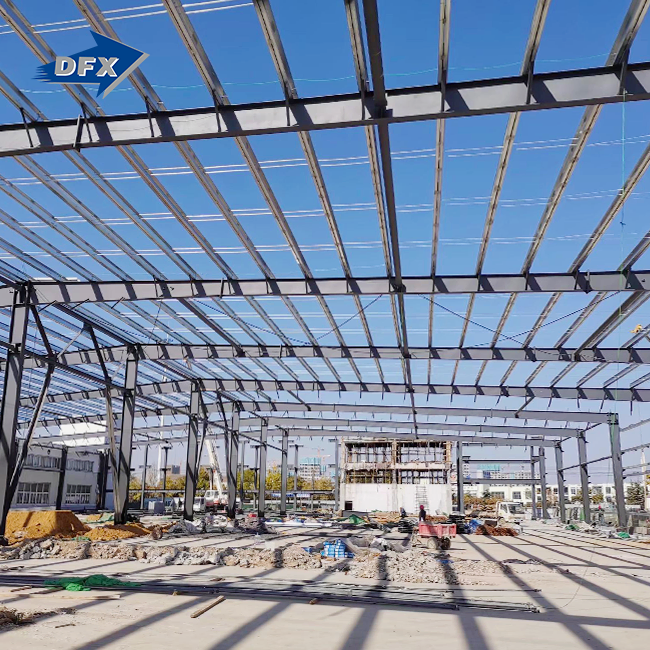
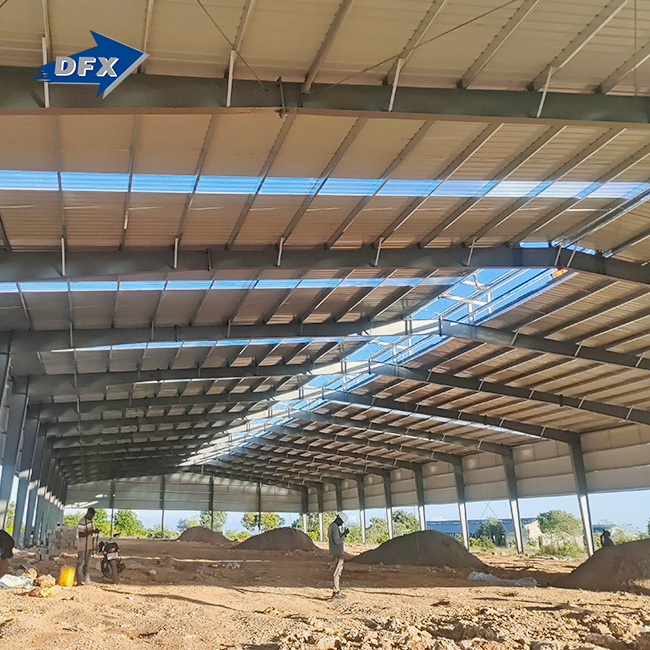
A quick assembly steel logistics warehouse is a pre-engineered modular storage structure. It consists of a primary steel structure with high-strength H-beams, welded C/Z section purlins, and a built-in bracing system. All the key components are constructed off-site in controlled circumstances and delivered to the site as a kit of parts ready for speedy assembly.
This system has a clear-span architecture that differs from prior builds. Clear spans of 24 to 50 meters are achievable if there are no internal beams to interfere with floor space. This offers the logistics managers complete control over the arrangement of the racks, the movement of the forklifts, and the division of the items. Buildings are often constructed with sandwich panels or corrugated steel sheets. The building enclosure keeps the structure warm and dry without adding weeks to the schedule.
These buildings are accredited to ISO9001 and CE standards. They may also be certified to EN1090 if required, demonstrating compliance with outside engineering and procurement requirements.
Key Design and Construction Considerations
Material Selection and Structural Integrity
High-tensile steel, usually Grade Q355B or ASTM A572 Gr. 50, with a yield strength of ≥345 MPa, is used for the main frame. Cold-formed galvanized steel with a zinc coating thickness of at least 275 g/m² is used for the secondary framing. This type of steel is very resistant to corrosion and can be used in harsh environments.
Polyurethane sandwich panels are good for climate-controlled areas, and standing seam metal roofing is good for places that need something that will last a long time. Coatings that are resistant to salt spray are used during manufacturing to make industrial parks near the coast last longer.
Compliance, Safety, and Lead Times
Safety compliance is embedded in the design process from the very start. The structure is fire-resistant thanks to intumescent coatings and non-flammable Rockwool or PIR screens. It satisfies fire ratings of REI 60-120, depending on your local regulations. They may be utilized in many regions since the structures are designed to resist wind up to 150 km/h and earthquakes up to Grade 8+.
A fast assembly steel logistics warehouse of medium size (5,000-10,000 m²) may be built in 8-16 weeks, whereas an equivalent concrete construction requires 6-12 months. Because the design needs to be authorized first. This reduced timeline clearly correlates with quicker operational preparedness and a better return on investment.
How Steel Warehouses Compare to Alternative Solutions
Choosing the right fast assembly steel logistics warehouse structure includes weighing development speed, lifetime cost, adaptability, and environmental impact. This is how steel stacks up against other popular materials:
- Steel vs. Concrete: Building a building of the same size out of reinforced concrete takes two to three times as long and costs a lot more to tear down when it's done. Steel, on the other hand, can be recycled 85–90% of the time, which lowers its long-term impact on the environment while keeping its structural integrity for 50 years or more.
- Steel vs. Prefabricated Wood: Wooden structures are cheaper to build at first, but they can't be as long and are more likely to catch fire. Steel has clear spans that wood just can't match, which makes it the best material for automated storage systems and high-bay racks.
- Steel vs. Modular Tent/Fabric Structures: Temporary fabric warehouses are good for short-term needs, but they can't support suspended MEP systems, rooftop solar installations, or overhead cranes, all of which are becoming more common in modern logistics.
Steel has more than just speed going for it. By taking off the end-wall cladding and adding new bays, a fast assembly steel logistics warehouse can be made longer, which gives operators a real way to grow without having to start from scratch. This ability to add on to modules is one of the main benefits that concrete and wood buildings can't match.
Selecting the Right Supplier and Solution for Your Logistics Needs
What to Look for in a Steel Warehouse Manufacturer
Purchasing managers and project engineers reviewing suppliers should look for certificates that can be verified, in-house technical expertise, and clarity of manufacturing procedures. A good steel structure supplier does not just supply raw materials. They also provide engineering estimates, production drawings, transportation management, and on-site installation help as part of a whole package.
When you look at quotations, don't simply look at unit pricing. Does the supplier provide structural design assistance? Can you adapt standard units to your site circumstances, the quantity of items, and the climate? Is it possible to receive MTCs (mill test certificates) for every primary steel? These subtleties demonstrate the distinction between a genuine production partner and a basic provider of materials.
Turnkey Solutions vs. Supply-Only Contracts
Many business-to-business clients, especially EPC contractors and industrial investors, get the most out of a "turnkey" approach, in which one provider takes care of planning, production, shipping, and installation advice. This lowers the chance of communication problems, speeds up the project, and gives everyone responsible one point of contact throughout the whole build cycle.
Supply-only contracts are good for contractors who already have erection teams in place, but the buyer has to handle the engineering side of the deal on their own. Both models work; the right one for you depends on how skilled your team is and how complicated the project is.
Practical Cases and Future Outlook
Real Applications Across Industries
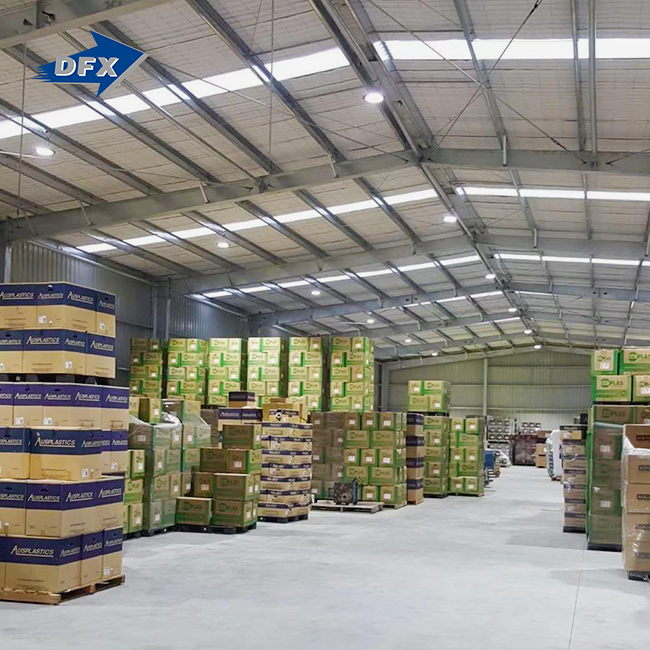
Steel structures for transport may be employed in a variety of environments. E-commerce distribution centers take advantage of the clear-span construction to install automated storage and retrieval systems (AS/RS) and multi-level mezzanines for picking and packaging. Cold chain distribution hubs include PU panel envelopes of 100-200 mm thickness that maintain temperatures steadily between -25°C and +5°C, and the steel frame does not rust from humidity. Cross-docking facilities are ideal for swiftly transferring large quantities of products regardless of the weather, thanks to wide-span loading bays and 5-10-meter canopy overhangs.
In the future, putting solar PV systems on the roof will not be a choice, but will be normal. The steel roofing is designed to take an additional 15–20 kg/m 2 of weight on the roof. Building Information Modeling (BIM) is also revolutionizing the way work is done from design to manufacturing. This reduces coordination blunders and reduces wait times even further. If procurement executives want to invest in infrastructure now, it is wise to pick a steel warehouse system that can accommodate these modifications that are ready for the future.
Conclusion
Procurement experts, project managers, and operations directors know that in terms of speed of construction, long-term durability, space efficiency, and the potential to expand with the company, a constructed fast assembly steel logistics warehouse always fits the bill. These structures are safer, less expensive, and endure longer than most because they are built with approved materials, have clear spans, and are assembled in modules. For any manufacturing, distribution, or logistics operation that has to be up and operating swiftly and reliably for the long term, a steel warehouse solution should be thoroughly considered.
FAQ
1. How quickly can a steel logistics warehouse be operational?
A normal 5,000–10,000 m² steel logistics warehouse takes 8–16 weeks to build from the time the plan is approved to the time the structure is finished. It takes 6–12 months for concrete versions. This shorter schedule is due to off-site prefabrication, in which parts are made while the site is being prepared.
2. What are the primary cost components in a steel warehouse project?
The main things that affect the cost are the major steel frame materials, cladding systems (roof and wall panels), base work, and workers for putting the building together. Depending on the supplier's service model, engineering design, shipping, and installation help services may be priced together or separately.
3. Can the structure be expanded after initial construction?
Yes, pre-engineered steel buildings are made with end-wall frames that can be expanded. This lets you add horizontal bays without affecting the structure. Because it can be expanded in modules, steel is the best material for businesses that expect to grow.
4. Are these warehouses suitable for cold storage or high-humidity environments?
Of course. With the right insulation panels (PU/PIR, 100–200 mm) and thermal break detailing, the structure keeps its internal temperatures under control and doesn't rust from condensation, which is very important for cold chain and coastal logistics operations.
Partner with DFX for Your Next Steel Warehouse Project
Since 2011, DFX (Qingdao Director Steel Structure Co., Ltd.) has sold certified steel structures all over the world. As a reliable ast assembly steel logistics warehouse maker, we offer full solutions, including engineering calculations, ISO9001/CE-certified fabrication, logistics planning, and help with setting up. Get in touch with our technical team at jason@bigdirector.com to get a quote for your project and find out how DFX can speed up your next logistics infrastructure investment.
References
1. Metal Building Manufacturers Association (MBMA). Metal Building Systems Manual. 2022.
2. Steel Construction Institute (SCI). Design of Steel Structures for Buildings. 2019.
3. McKinsey & Company. Reimagining Industrial Footprints: The Logistics Real Estate Opportunity. 2021.
4. American Institute of Steel Construction (AISC). Steel Construction Manual, 16th Edition. 2023.
5. International Journal of Steel Structures. Structural Performance of Pre-Engineered Steel Buildings Under Dynamic Loads. 2020.
6. CBRE Research. Global Logistics & Industrial Real Estate Outlook. 2023.
Learn about our latest products and discounts through SMS or email