- English
- French
- German
- Portuguese
- Spanish
- Russian
- Japanese
- Korean
- Arabic
- Greek
- German
- Turkish
- Italian
- Danish
- Romanian
- Indonesian
- Czech
- Afrikaans
- Swedish
- Polish
- Basque
- Catalan
- Esperanto
- Hindi
- Lao
- Albanian
- Amharic
- Armenian
- Azerbaijani
- Belarusian
- Bengali
- Bosnian
- Bulgarian
- Cebuano
- Chichewa
- Corsican
- Croatian
- Dutch
- Estonian
- Filipino
- Finnish
- Frisian
- Galician
- Georgian
- Gujarati
- Haitian
- Hausa
- Hawaiian
- Hebrew
- Hmong
- Hungarian
- Icelandic
- Igbo
- Javanese
- Kannada
- Kazakh
- Khmer
- Kurdish
- Kyrgyz
- Latin
- Latvian
- Lithuanian
- Luxembou..
- Macedonian
- Malagasy
- Malay
- Malayalam
- Maltese
- Maori
- Marathi
- Mongolian
- Burmese
- Nepali
- Norwegian
- Pashto
- Persian
- Punjabi
- Serbian
- Sesotho
- Sinhala
- Slovak
- Slovenian
- Somali
- Samoan
- Scots Gaelic
- Shona
- Sindhi
- Sundanese
- Swahili
- Tajik
- Tamil
- Telugu
- Thai
- Ukrainian
- Urdu
- Uzbek
- Vietnamese
- Welsh
- Xhosa
- Yiddish
- Yoruba
- Zulu
Can a metal frame structure be used for sports facilities?
Absolutely. Metal frame structures, particularly steel sports facilities, are not only viable but have also become the preferred solution for modern athletic infrastructure worldwide. Steel's exceptional strength-to-weight ratio, combined with its ability to span vast distances without intermediate columns, makes it ideal for gymnasiums, indoor arenas, training centers, and even Olympic-scale stadiums. We've witnessed procurement managers across construction, manufacturing, and infrastructure sectors increasingly selecting steel frameworks because they deliver clear-span interiors essential for unobstructed sightlines and flexible layouts. Beyond structural performance, steel offers rapid construction timelines and adaptable design features that accommodate diverse sporting activities—from basketball courts to swimming complexes.

Introduction
The way we build steel sports facilities around the world has changed because of metal frame buildings. Steel's high load-bearing capacity, resistance to corrosion, and ability to be designed in a variety of ways help project managers and procurement directors solve important problems. For builders working on multimillion-dollar projects, steel takes away the problems that come with using traditional materials like wood or concrete. Because it is flexible, it cuts down on on-site work, speeds up projects by 30 to 50 percent, and reduces weather-related delays. When procurement professionals know about these benefits, they can make better decisions about performance, cost management, and sustainability, which are the three main factors that make an infrastructure investment successful. This guide talks about why steel is so important in building athletic venues and how your group can make the most of it.
What Are Metal Frame (Steel) Structures in Sports Facilities?
Metal frame structures in sports arenas are made up of designed steel parts called H-beams, columns, trusses, and purlins. These make up the skeletal framework that supports roofs, walls, and other architectural elements. High-tensile steel alloys (usually G450 or G550 grade) are used in these systems. They have yield strengths between 450 and 550 MPa, which means they will stay stable even when there is heavy snow, earthquakes, or high winds that are common in open areas.
Core Components and Their Functions
The structure is made up of vertical columns that are anchored to reinforced foundations, horizontal beams that make up the roof grid, and secondary members like C/Z-section purlins that spread the loads on the cladding. Clear spans of more than 80 meters are possible with steel portal frames or beam-column designs. This is important for indoor soccer fields or ice hockey rinks where inner columns would get in the way of play zones. Modern welding methods and fixed links make assembly quick while keeping the structure strong.
Facility Types and Classifications
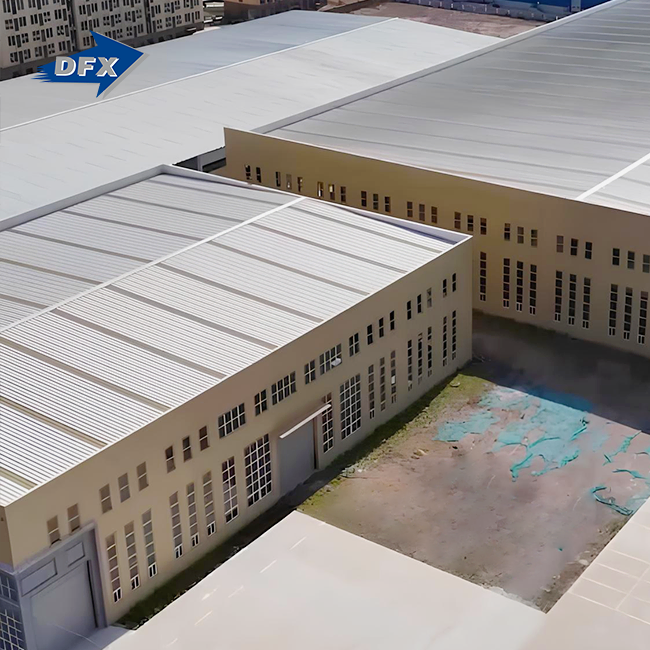
Steel-framed steel sports facilities come in all shapes and sizes, from small community gyms to huge professional grounds. For temperature control, indoor halls usually have rigid frame systems with insulated sandwich panels. Outdoor stadiums, on the other hand, use truss systems to support cantilevered roofs that protect fans without blocking their views. Prefabricated modular buildings are a cost-effective option for schools and cities because they come to the site with pre-cut parts that can be put together in weeks instead of months.
Advantages Over Traditional Materials
When compared to reinforced concrete, steel can be put together with faster erection speeds and has superior tensile strength, so there are no curing times that slow down building plans. Steel, unlike wood, doesn't get damaged by water, termites, or fungus growth. This is very important in humid places or places with swimming pools. Its non-combustible properties raise its fire safety ratings, which lowers insurance costs and helps buildings meet strict building rules. Because the material is flexible, builders can make unique roof shapes like arched spans, bent profiles, or asymmetric designs that would not be possible with hard concrete formwork.
How Are Steel Sports Facilities Built? A Step-by-Step Overview
Building a steel-framed steel sports facilities complex follows a carefully thought-out order that ensures quality control and efficiency. Over the past 12 years, we've improved this process by building everything from airplane hangars to business buildings. The same method works perfectly for building sports infrastructure.
Strategic Planning and Architectural Design
The first step is for project engineers to talk to stakeholders and figure out what the functional requirements are. These include the size of the court, the number of seats available, and any extra spaces like locker rooms and concession stands. Then, structural engineers make load calculations that take into account wind zones, snow buildup, and seismic factors in the area. Our in-house architectural design team turns these needs into detailed plans by making sure that the bay spacing and eave heights are just right so that mechanical systems and lighting rigs can fit.
Off-Site Fabrication and Quality Assurance
Steel parts are made in controlled factories, which ensures a level of accuracy that can't be achieved by building them on-site. Six automatic welded H-beam production lines and two C/Z section steel lines are run at our plant. Each year, they make about 20,000 tons of structural members for various applications, including steel sports facilities. Each beam's surface is treated with either hot-dip galvanization or aluminum-zinc alloy coatings (AZ150 to AZ275 grade), which meet ASTM A792 standards for corrosion resistance. Every step of the welding process, including checking the dimensions and measuring the thickness of the coating, is governed by ISO quality management systems. CE certification proves that the work meets European structure standards.
On-Site Erection and Modular Assembly
Prefabricated parts come pre-labeled and in the right order for assembly, which cuts down on the need for on-site work by up to 60%. Crane workers put columns into base anchor bolts and then lift the main beams into place. Bolted connections allow fast joining without hot work permits, which speeds up plans in cities with strict safety rules. Next comes the secondary framing, which is made up of purlins and girts. These hold up the corrugated steel roofing sheets and wall covering systems. Our erection support services help contractor teams through this step and make sure that alignment margins are kept to a few millimeters.
Maintenance Practices for Longevity
After the building is finished, regular inspections find problems with the coating or the fasteners before they become structural. Simple maintenance protocols, like putting on new protective coatings every 10 to 15 years and tightening connections, can make something last longer than 50 years. Steel is naturally stable, so it doesn't need to be treated for pests or cracked concrete like concrete does. This means that it costs less to maintain over its lifetime.
Comparing Steel Sports Facilities with Alternatives: Informed Decision-Making
When purchasing building materials, procurement managers have to weigh the costs up front, the materials' stability, and their ability to be used in different ways. We've looked at these factors in hundreds of projects and found patterns that help us make strategic decisions regarding steel sports facilities.
Durability and Structural Performance
Steel's tensile strength is over 40% higher than concrete's, which lets buildings have thinner profiles that lower foundation costs and dead loads. Concrete's compression strength makes it good for load-bearing walls, but it needs to be cut into thick pieces that take up floor space and make repairs harder. Because wood is organic, it can be damaged by water and living things. To treat it, chemicals are used, which is bad for the environment. Steel keeps its shape even when the temperature changes, so it doesn't get the cracks that happen when concrete slabs expand or when wooden frames bend.
Lifecycle Cost Analysis
When it comes to initial material prices, steel is in the middle of cheap wood choices and high-end concrete systems. However, lifecycle assessments show that steel is a better value. Commercial operators can start making money earlier when construction times are cut by 20%. For example, a 20% schedule reduction on a $5 million project saves $200,000 in financing costs and lost opportunities. Less upkeep tips the balance even more; steel doesn't need as much work as concrete does, which needs to be sealed every so often, and wood needs to be replaced every so often. Insurance companies know that steel is fire-resistant and reliable, so they offer rate discounts of 15 to 25 percent over combustible options.
Flexibility and Future Adaptability
As sports trends and community needs change, so do athletic facilities. Steel is flexible, so it's easy to add on, like adding bays, raising roof heights, or adding mezzanines, without affecting the structure's strength. Because concrete is solid, it can't be changed, so expensive demolition is often needed. This ability to adapt makes assets last longer and saves the value of investments as building needs change over time.
Sustainability and Environmental Benefits of Steel Sports Facilities
Sustainable building practices are becoming more and more important because of corporate responsibility laws. This means that choosing the right materials for steel sports facilities is more than just a matter of how well they work structurally. Steel is in line with these needs because it has many environmental benefits.
Recyclability and Circular Economy Integration
With recycled material recovery rates of over 85% in developed markets, steel is the most recycled material in the world. When structural members in steel sports facilities reach the end of their useful lives, they keep all of their material value and can be used to make new beams without losing any of their quality. This closed-loop system is very different from concrete, which usually ends up as low-grade aggregate, or treated wood that ends up in dumps. Choosing steel with recycled material lowers total carbon by up to 30%. This directly supports LEED and BREEAM certification goals that make the building more marketable and acceptable to the community.
Energy Efficiency Through Design Optimization
Steel frames allow for high-performance building envelopes by allowing thick insulation layers to be added to the walls and roof. Adding thermal breaks to the connections between columns stops heat from moving, which lowers the load on HVAC systems in climate-controlled arenas. When compared to dark asphalt systems, reflective metal roofing cuts down on solar heat gain even more, which means that 20–35% less cooling energy is used. Over operating lifetimes measured in decades, these efficiencies add up to big savings on energy costs.
Long Service Life and Resource Conservation
Steel buildings usually last 50 to 75 years if they are well taken care of, which is twice as long as the average wood-framed building. Long service life periods delay the need for replacement materials, which saves resource conservation and keeps demolition waste from being created. This durability helps public sector clients with tight budgets the most, since suspended capital expenditures free up money for community and educational services.
Procurement Guide for Steel Sports Facilities: How to Choose and Where to Buy?
Figuring out how to get steel sports facilities requires looking at technical expertise, manufacturing capacity, and service commitments that set reliable partners apart from less-than-reliable suppliers.
Evaluating Manufacturing Capacity and Technical Expertise
Qualified providers keep up a large production system that can handle projects ranging in size from 500-ton community centers to 5,000-ton regional stadiums. We have 40,000 square meters of protected manufacturing space with dedicated production lines for six types of welded H-beams, two types of sandwich panels, and twenty types of corrugated sheeting. This lets us work on multiple projects at the same time without any schedule problems. Make sure that any potential suppliers you talk to have certified welders and quality inspectors who are trained to AWS D1.1 or a similar standard.
Quality Certifications and Compliance Documentation
For international projects, the products need to meet the standards of the final market. ISO 9001 certification shows that quality management is organized, and CE marking proves that the product meets European building standards. More certifications make it easier to clear customs in African markets. Ask for mill test reports that show the chemical makeup and mechanical qualities of the steel, as well as measures of the coating thickness to prove that it meets the requirements for corrosion protection.
Service Scope and Turnkey Capabilities
Comprehensive sellers offer turnkey capabilities, from idea design to erection support. This gets rid of the planning problems that come with using more than one vendor. Our architectural design and detailing service turns what our clients want into drawings that can be made, and our surface treatment facilities put on protective coatings. On-site construction support keeps installation mistakes from being too expensive and makes sure that the structure works with single-point accountability.
Pricing Structures and Lead Time Expectations
The pricing structures of a steel structure depend on the type of material used, the finishing requirements, and how complicated the customization is. Standard portal frame systems cost $150 to $250 per square meter to install. More complicated designs with curved curves cost $300 to $400 per square meter. Made-to-order production usually takes 6–10 weeks for fabrication and shipping lead times, which is shorter than concrete building but needs a commitment to buy earlier. Set up clear payment terms that are in line with the project's milestones.
Conclusion
Metal frame structures have been used in thousands of steel sports facilities around the world and have been shown to be the best in terms of structural performance, speed of construction, and long-term value. Steel is the best material for managing sports infrastructure projects because it can be used to make large, clear-span spaces, withstand high environmental loads, and change to meet new functional needs. Environmental benefits like high recycling, low energy use, and long service life are in line with business sustainability requirements that are becoming more and more important in project decisions. Construction contractors, EPC companies, and building managers can get reliable results that meet performance needs and price limits by working with experienced manufacturers that offer full design-through-erection services.
FAQ
1. How durable are steel sports facilities in extreme weather conditions?
Steel buildings that are designed to withstand the wind, snow, and earthquakes in their area work effectively in tough environments. Surface treatments like hot-dip galvanization or aluminum-zinc coatings keep things from rusting in wet seaside or industrial settings. In cyclonic areas, buildings get stronger connections and better anchorage systems that can handle wind speeds of more than 150 mph. Thermal breaks in cold climate facilities keep ice from forming, while reflective surfaces in dry facilities control thermal expansion. With the right planning, steel facilities can work well in both Arctic and tropical settings.
2. What are typical lead times from order to installation?
Standard steel sports facilities projects need 6–10 weeks to make the parts and then 3–6 weeks for shipping, depending on where the parts are going. Building buildings smaller than 5,000 square meters takes 4 to 8 weeks to put together on-site. From order confirmation to operating readiness, the average project takes 4-6 months. This is a lot less time than concrete options, which take 9–12 months. When the project needs to be done quickly enough to justify the extra cost, expedited production plans can cut down on time by 20 to 30 percent.
3. How do maintenance costs compare to alternative materials?
Maintenance costs are lower for steel sports facilities than for concrete or wood ones. The average cost of an annual inspection and minor touch-up coating is $0.50 to $1.50 per square meter. This is less than the $2 to $4 cost of fixing cracks in concrete and waterproofing it, or the $3 to $6 cost of keeping pests away from wood and strengthening the structure. Over 30-year lifecycles, steel maintenance costs 40–60% less than other options, which helps operational budgets and asset values.
Partner with DFX for Your Next Steel Sports Facility Project
With over 200 skilled workers and 12 years of experience, DFX is ready to help you realize your goal for your athletic infrastructure. As a well-known steel sports facilities maker, we've completed projects ranging from airplane hangars to commercial buildings. We use this knowledge to build gyms, indoor arenas, and training centers all over the world. Our six automatic H-beam lines and many surface treatment facilities, along with our ISO-certified production methods, make sure that the structural parts we make meet international quality standards and are backed by CE certification. We offer integrated solutions that cover every stage of your project's development, from idea creation to on-site erection support. Contact our team at jason@bigdirector.com to discuss your specific needs.
References
1. American Institute of Steel Construction. (2021). Design Guide 23: Structural Steel for Modular Buildings. Chicago: AISC Publications.
2. Lawson, R.M., & Ogden, R.G. (2020). Sustainable Steel Construction: Design and Practice for Sport and Leisure Buildings. London: The Steel Construction Institute.
3. International Olympic Committee. (2019). Sustainable Infrastructure Guidelines for Olympic Venues: Material Selection and Lifecycle Assessment. Lausanne: IOC Sustainability Commission.
4. Chen, W.F., & Lui, E.M. (2018). Handbook of Structural Engineering: Long-Span and Sports Facility Design. Boca Raton: CRC Press.
5. Building Research Establishment. (2020). BREEAM Technical Manual: Steel-Framed Sports and Recreation Buildings. Watford: BRE Global Ltd.
6. National Association of Sports Commissions. (2022). Procurement Best Practices for Athletic Facility Construction: Material and Contractor Selection Criteria. Indianapolis: NASC Industry Reports.
Learn about our latest products and discounts through SMS or email