- English
- French
- German
- Portuguese
- Spanish
- Russian
- Japanese
- Korean
- Arabic
- Greek
- German
- Turkish
- Italian
- Danish
- Romanian
- Indonesian
- Czech
- Afrikaans
- Swedish
- Polish
- Basque
- Catalan
- Esperanto
- Hindi
- Lao
- Albanian
- Amharic
- Armenian
- Azerbaijani
- Belarusian
- Bengali
- Bosnian
- Bulgarian
- Cebuano
- Chichewa
- Corsican
- Croatian
- Dutch
- Estonian
- Filipino
- Finnish
- Frisian
- Galician
- Georgian
- Gujarati
- Haitian
- Hausa
- Hawaiian
- Hebrew
- Hmong
- Hungarian
- Icelandic
- Igbo
- Javanese
- Kannada
- Kazakh
- Khmer
- Kurdish
- Kyrgyz
- Latin
- Latvian
- Lithuanian
- Luxembou..
- Macedonian
- Malagasy
- Malay
- Malayalam
- Maltese
- Maori
- Marathi
- Mongolian
- Burmese
- Nepali
- Norwegian
- Pashto
- Persian
- Punjabi
- Serbian
- Sesotho
- Sinhala
- Slovak
- Slovenian
- Somali
- Samoan
- Scots Gaelic
- Shona
- Sindhi
- Sundanese
- Swahili
- Tajik
- Tamil
- Telugu
- Thai
- Ukrainian
- Urdu
- Uzbek
- Vietnamese
- Welsh
- Xhosa
- Yiddish
- Yoruba
- Zulu
Why Choose an AISC-certified large-span steel structure hangar
When you need a hangar that can shelter wide-body aircraft, heavy industrial equipment, or large military assets, the structural stakes are simply too high to compromise. An aisc certified large-span steel structure hangar meets the rigorous fabrication and safety standards set by the American Institute of Steel Construction, giving procurement professionals a clear, verifiable benchmark for quality. Whether you manage an EPC project, operate an MRO facility, or oversee airport infrastructure, choosing a certified wide-span steel hangar means fewer compliance headaches, longer service life, and greater confidence in every weld and bolt.

Understanding AISC Certification and Its Importance for Large-Span Steel Hangars
The American Institute of Steel Construction has been running its certification program since 1928. Its quality framework now encompasses fabrication techniques, material traceability, inspection procedures, and erection standards – norms that directly affect the structural dependability of an AISC-certified large-span steel hangar.
What AISC Certification Actually Verifies
When a fabricator has AISC clearance, they are certifying that they have followed set quality management processes, use qualified welders, and use traceable steel materials that are in recognized grades such as ASTM A572 Gr.50 or similar Q355B. For B2B buyers, it means you have independent, third-party certification of production quality, not a manufacturer’s self-declaration. And that distinction matters if you need to protect tens of millions of dollars of assets with some kind of framework.
Why Global Procurement Teams Prioritize Certified Suppliers
Certified steel hangar constructions conform to international safety requirements, including IBC, AISC 360, and MBMA norms. This facilitates easier approval across countries, especially in the United States, and decreases the chance of expensive retrofits or regulatory rejections post-delivery. Such regulatory certainty is essential to EPC contractors and infrastructure project managers operating across different areas.
Key Design Considerations and Construction Process of AISC-Certified Large-Span Steel Hangars
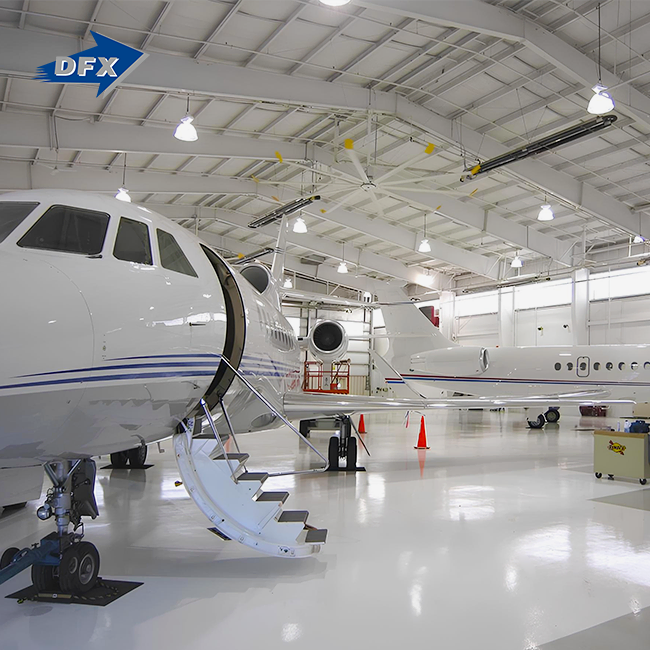
It takes careful planning from the start to build an aisc certified large-span steel structure hangar that covers 60 meters or more without intermediate columns. To meet certification standards, the fabrication sequence—from structural calculation through customized design, steel cutting, welding, and final quality inspection—must follow documented procedures.
Critical Load and Span Engineering Factors
The approval for the wide-span hanger construction should be made to withstand the wind lifting loads that come with an open airport, snow buildup in the north, and earthquake pressures in the busy zones. The main entrance structure is made up of H-section steel frames and beams that are welded together and have a method for supporting them. Grade of steel. High-strength friction grip nuts are used for the connections. Shot blasting to Sa2.5 and an epoxy zinc-rich primer are used to stop corrosion. These are choices that were made during the planning phase and can't be changed later.
Most hangars have clear widths of 30 meters for general flight and over 100 meters for wide-body business MRO activities. It is estimated that the bay spacing, roof pitch, eave height, and door opening width will work with certain types of aircraft, overhead cranes, and building codes in the area.
The main building features of an approved large-span hangar are:
- Welded H-section for the main frame. It holds up the whole building and is made to handle vertical dead loads as well as side forces from wind or earthquakes. The H-beams are made on automated welding lines that make sure the lengths are all the same and the connections are solid.
- Reinforced bracing system: diagonal bracing in the roof and wall planes keeps the frame stable against horizontal loads, which keeps it from breaking during wind events that are common at open airfields. Not guesswork, but structural analysis is used to figure out how big the system should be.
- Certified walls and roof: Sandwich panels or perforated steel sheets with a PVDF covering seal the building shell. Insulated panels with PU cores help keep the temperature inside stable so that electronics can be worked on or temperature-sensitive gear can be stored.
Comparative Advantages of AISC-Certified Steel Hangars Over Alternatives
“An AISC-certified large-span steel structure hangar is often compared by procurement managers to non-certified steel buildings, reinforced concrete construction, and pre-engineered alternatives without quality documentation. The distinctions are substantive, not superficial.
Quality Assurance and Warranty Differentiation
All projects have verified inspection records, material certifications, and weld technique qualifications from a recognized fabricator. Non-certified vendors could provide cheaper initial quotations, but if quality paperwork isn’t traceable, customers are taking the risk of structural problems that are only found after installation. Concrete hangars are more robust, but take 30-50% longer to build and have far less flexibility for future span extension or crane integration.
The World Steel Association reports that steel is highly recyclable, with a recyclability rate of over 90% at end of life, making certified steel hangars a good option for businesses who want to demonstrate environmental responsibility. Where prefabricated steel is modular, future bays may be added without having to tear down the present structure — a benefit concrete just cannot equal.
Procurement Insights: How to Select the Right AISC-Certified Large-Span Steel Hangar
Navigating the purchasing process for an aisc certified large-span steel structure hangar from inquiry to delivery requires clarity on several interconnected variables. Lead times for customized fabrication typically range from 8 to 16 weeks depending on span dimensions, steel volume, and surface treatment complexity. Buyers should request itemized cost breakdowns covering raw material grade, fabrication labor, surface treatment, and shipping to make meaningful supplier comparisons.
Evaluating a Reliable Certified Manufacturer
When evaluating possible suppliers, choose those that provide in-house structural computation and detailing services rather than outsourcing engineering. A full-scope provider of design, manufacturing, and installation assistance eliminates coordination risk and speeds project schedules. Ask for factory audit paperwork, welder qualification records, and sample quality inspection reports prior to issuing a purchase order. ISO 9001 Quality Management Certification, CE Marking (Conformity with European Standards), COC or PVOC Certificate (For Certain Export Markets)
Ensuring Long-Term Safety and Performance of Your Steel Hangar
Proper maintenance makes a well-designed AISC-certified large-span steel structure hangar valuable. Anti-corrosion coatings on steel buildings in coastal or high-humidity settings should be inspected every three to five years and recoated before the base metal is exposed. Primary structural elements are coated with intumescent fireproof coatings and have fire ratings of one to three hours. In the United States, NFPA 409 is the standard for aviation hangars. Periodic inspections of high-strength bolt connections, roof panel seals, and gutter drainage systems may prevent small problems from becoming structural problems.
Conclusion
Choosing an aisc certified large-span steel structure hangar is a decision that shapes project safety, regulatory standing, and long-term operational cost. AISC standards provide a verifiable quality baseline that protects B2B buyers from structural risk and compliance uncertainty. With ISO 9001 quality systems, CE certification, and competent in-house engineering, the right manufacturer delivers not just steel components but a complete, traceable building solution. Certification is the foundation on which reliable procurement decisions are built for aircraft hangars, heavy equipment shelters, and large industrial facilities alike.
FAQ
1. What clear spans are achievable with a certified large-span steel hangar?
Clear spans for an AISC-certified large-span steel structure hangar typically range from 30 meters for light aircraft to over 100 meters for wide-body commercial aircraft or heavy industrial applications. Structural engineers calculate the optimal frame geometry during the design phase based on aircraft wingspans and local load codes.
2. How long does fabrication and delivery take?
Customized fabrication generally requires 8 to 16 weeks from design confirmation to factory completion. Shipping duration adds additional time depending on destination. Buyers should factor permitting and foundation preparation into the overall project schedule.
3. Can the hangar accommodate overhead cranes?
Yes. Bridge cranes rated from 2 to 20 tons can be supported by main frame columns that have integrated crane runway beams. Crane loads must be included in the initial structural calculation to ensure columns and foundations are properly sized.
4. What certifications should I require from my supplier?
At minimum, verify ISO 9001, CE marking, and any destination-specific certificates such as COC or PVOC. These credentials confirm the fabricator operates under documented quality management systems and meets international construction material standards.
5. Is a steel hangar suitable for coastal or high-humidity environments?
Yes, provided appropriate anti-corrosion treatment is specified. Hot-dip galvanizing with coating thickness above 85 microns or marine-grade epoxy paint systems with PVDF cladding coatings are standard solutions for coastal environments.
Partner with DFX for Your Next AISC-Certified Large-Span Steel Structure Hangar Project
Since 2011, DFX — Qingdao Director Steel Structure Co., Ltd. — has delivered certified wide-span steel buildings across aviation, industrial, and infrastructure sectors. As a trusted aisc certified large-span steel structure hangar supplier, we offer complete services from structural calculation and customized design through fabrication and installation guidance, backed by ISO 9001, CE, COC, and PVOC certifications. Reach our engineering team directly at jason@bigdirector.com to discuss your project specifications and receive a tailored proposal.
References
1. American Institute of Steel Construction (AISC). Steel Construction Manual, 16th Edition. AISC, 2023.
2. Metal Building Manufacturers Association (MBMA). Metal Building Systems Manual. MBMA, 2022.
3. National Fire Protection Association. NFPA 409: Standard on Aircraft Hangars. NFPA, 2022.
4. World Steel Association. Steel's Contribution to a Low Carbon Future and Climate Resilient Societies. World Steel Association, 2021.
5. International Building Code Council. International Building Code (IBC). ICC, 2021.
6. American Institute of Steel Construction (AISC). AISC 360-22: Specification for Structural Steel Buildings. AISC, 2022.
Learn about our latest products and discounts through SMS or email