- English
- French
- German
- Portuguese
- Spanish
- Russian
- Japanese
- Korean
- Arabic
- Greek
- German
- Turkish
- Italian
- Danish
- Romanian
- Indonesian
- Czech
- Afrikaans
- Swedish
- Polish
- Basque
- Catalan
- Esperanto
- Hindi
- Lao
- Albanian
- Amharic
- Armenian
- Azerbaijani
- Belarusian
- Bengali
- Bosnian
- Bulgarian
- Cebuano
- Chichewa
- Corsican
- Croatian
- Dutch
- Estonian
- Filipino
- Finnish
- Frisian
- Galician
- Georgian
- Gujarati
- Haitian
- Hausa
- Hawaiian
- Hebrew
- Hmong
- Hungarian
- Icelandic
- Igbo
- Javanese
- Kannada
- Kazakh
- Khmer
- Kurdish
- Kyrgyz
- Latin
- Latvian
- Lithuanian
- Luxembou..
- Macedonian
- Malagasy
- Malay
- Malayalam
- Maltese
- Maori
- Marathi
- Mongolian
- Burmese
- Nepali
- Norwegian
- Pashto
- Persian
- Punjabi
- Serbian
- Sesotho
- Sinhala
- Slovak
- Slovenian
- Somali
- Samoan
- Scots Gaelic
- Shona
- Sindhi
- Sundanese
- Swahili
- Tajik
- Tamil
- Telugu
- Thai
- Ukrainian
- Urdu
- Uzbek
- Vietnamese
- Welsh
- Xhosa
- Yiddish
- Yoruba
- Zulu
Grain Storage Steel Warehouse Design for Moisture Control
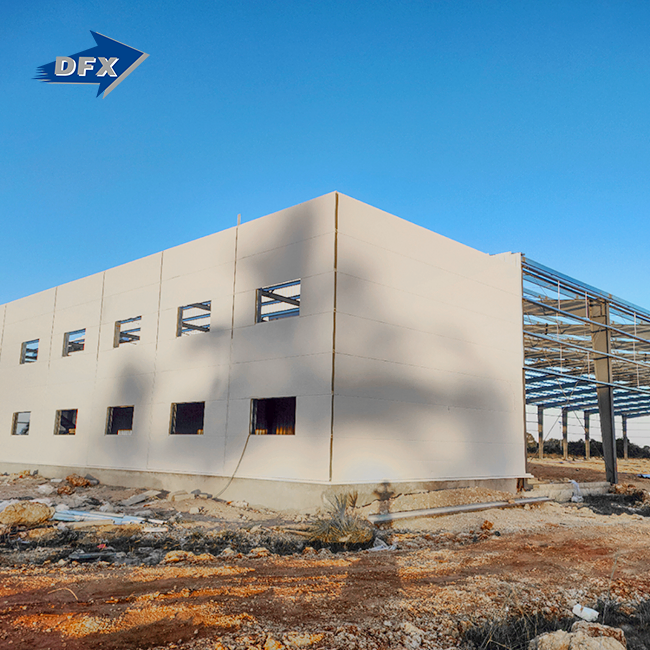
When grain spoils due to moisture intrusion, entire harvests can become worthless in an instant. A well-designed grain storage steel warehouse solves this important problem by including structural features that stop condensation, manage humidity, and keep goods safe from damage from the environment. Our modular premade steel storage solutions are made in China with H-beam main steel frames and galvanised C/Z purlins. They offer reliable moisture management systems that are specifically designed to meet the needs of farm storage operations.

Understanding Moisture Challenges in Grain Storage Steel Warehouses
Controlling moisture isn't just a technical matter; it's the difference between storing grains profitably and losing a lot of money. We've seen a lot of farms have trouble with condensation issues that cause mould to grow, aflatoxin poisoning, and food degradation. These problems are caused by basic environmental factors that every buying manager should know about before they spend money on a grain storage steel warehouse.
The Science Behind Moisture Accumulation
The right conditions for mist to form on steel surfaces are temperature differences between the inside and outside. Warm, muggy air hits cold steel walls or roofs, and water drops form. These droplets fall to the stored grain below. When the seasons change, and temperatures change a lot over the course of a 24-hour shift, this effect becomes especially annoying.
Through breathing, grain itself makes heat, which forms hot spots in storage piles. These warm spots hold more water than cooler spots, making the humidity level in your building uneven. If you don't have good airflow, this trapped moisture moves through the grains, making areas of damage that quickly spread through the whole storage space.
Financial Impact of Poor Moisture Management
When moisture control doesn't work, agricultural businesses lose money that can be measured. According to studies from the USDA Agricultural Research Service, grain rotting costs the American farming industry about $1 billion a year, with problems related to moisture making up about 40% of these losses. In addition to direct damage to goods, facilities also face regulatory compliance violations, pest populations drawn to damp conditions, and hastened structure corrosion that forces early replacement of the facility.
When choosing building systems, construction companies that are in charge of grain storage projects for clients need to take these future operating costs into account. If a grain storage steel warehouse saves 15% on initial building but doesn't have enough moisture barriers, it could cost customers three times as much in lost goods during the first harvest season alone.
Core Design Principles for Moisture Control in Grain Storage Steel Warehouses
Effectively preventing wetness starts with the engineering calculations, as the shape of the structure has a direct effect on how well it will store things over time. At DFX, we control moisture in every step of the manufacturing process, from choosing the materials to giving final instructions on how to put them together.
Vapour Barriers and Insulation Systems
Stopping outside water droplets from getting into buildings is the most basic way to control wetness. When put under roofing panels, high-performance vapour barriers stop the movement of moisture from the air into the roof. This keeps the structure strong even when there is a lot of snow or wind lifting. We combine these barriers with insulated sandwich panels that have polyurethane bases that reduce thermal bridging. This is when heat moves through structural parts and forms condensation zones.
Insulation has two uses in places where grain is stored. In addition to controlling the temperature, good insulation raises the surface temperatures inside above the dew point, which stops mist from forming no matter what the humidity levels are outside. Our sandwich panel systems have R-values between 20 and 30, which means they can be used in most temperature zones across the United States.
Ventilation Architecture
For many farm storage businesses, natural ventilation is still the most energy-efficient way to keep the air dry. When ridge ventilators are placed at roof peaks and eave inlets are used together, they create a constant flow of air that is caused by thermal buoyancy. As grain respiration warms the air inside, it rises and escapes through holes in the ridges. New, drier air comes in through lower entry vents.
When the weather is calm or the humidity is high, mechanical ventilation systems in a grain storage steel warehouse help the air move naturally. Aeration fans on the floor move air through open tubing that is buried in concrete slabs. This lets controlled air flow through grain masses. This active aeration takes moisture off of the surfaces of the grains while levelling out temperature differences that would otherwise make some areas more damp.
Climate Monitoring Integration
IoT sensor networks are being used more and more in modern grain storage facilities to keep track of temperature and relative humidity at various places throughout storage volumes. These automated systems let site managers know when conditions get close to dangerous levels, so they can take action before food goes bad. Our logistics coordination services help clients add these tracking technologies during the construction phase, making sure that the sensors are placed correctly and that the data is connected from the start.
Comparative Analysis: Steel Warehouses vs Other Materials for Moisture Control
The choice of material is very important for long-term success in managing wetness. We've built storage towers out of a range of different materials, which has given us a good understanding of how different building methods work in real-life farming settings.
Steel Structure Advantages
Steel is better for storing things that need to be kept dry because of the way it is naturally made. Steel, unlike wood, doesn't soak up water from the air or let mould grow on structure parts. The galvanised covering on our C/Z purlins and corrugated steel sheets protects them from rust and keeps the structure strong for decades, even in farming areas with a lot of moisture.
Because steel is dimensionally stable, it doesn't shift or move as wooden buildings do. This stability keeps the seals tight around doorways, panel joints, and roof overlaps, which are important places where air loss hurts efforts to keep wetness out. Our bracing systems make sure that buildings stay square and straight even when temperatures change with the seasons and cause them to expand and contract.
Because a grain storage steel warehouse is made up of separate modules, moisture barriers, insulation layers, and ventilation parts can be precisely put together during the manufacturing process. When buildings are put together in a factory, the conditions are controlled so that the quality is always the same. This is especially true for sealed joints and vapour barrier continuity.
Concrete and Wood Limitations
While concrete buildings are great at resisting side loads and keeping grain masses in place, they can be hard to keep dry. Because concrete is porous, water vapour can pass through walls unless expensive barriers are used to seal them. These membranes are very expensive and need to be carefully put in place so that they don't get holes that let other systems down.
Even though wood buildings are cheap at first, it breaks down quickly in damp grain storage areas. When structural parts absorb water, they swell, warp, and finally rot, so they need to be replaced every 15 to 20 years in normal farming use circumstances. Wood is also a home for bugs and fungi, which can lead to problems with cleanliness that are against the law in many places where food safety rules apply.

Best Practices & Maintenance for Moisture Control in Grain Storage Steel Warehouses
Even storage buildings that are properly built need regular maintenance to keep working at their best when it comes to controlling moisture. As part of our erection advice services, we offer operational training that helps site managers set up upkeep schedules that keep things from breaking down over time.
Preventive Inspection Schedules
Roof panel overlaps, wall joints, door seals, and the edges of the base should all be checked every three months for gaps that let air in. These small holes let wet air from outside into storage areas, which is too much for ventilation systems that are based on estimated air exchange rates. Sealant materials break down when exposed to UV light and high temperatures, so they need to be replaced every so often to keep moisture shields in place.
When it's wet, galvanised steel surfaces naturally get white rust, which is actually zinc oxide. This is a protective patina that makes the steel more resistant to rusting. But scratches or abrasions that reveal the base metal need to be fixed right away with zinc-rich primer coats to stop rust from spreading. We suggest writing down the state of the coating during each inspection cycle and keeping track of the rate of degradation to help with planning your repair budget.
Operational Moisture Management
How the grains are received has a big effect on the amount of moisture in the store. Receiving grain that has more wetness than what is safe for keeping (usually 13–14% for most cereals) will cause it to go bad quickly, no matter how well the Grain Storage Steel Warehouse is designed. Every load that comes in should be tested for moisture with a portable moisture meter. Grain that is too wet should be sent to aeration bins to dry out before being stored for a long time.
Temperature cables that are buried in grain piles let you know early on when there are hot places that mean living things are active. When corn starts to ferment, it makes heat that sensors can pick up before it starts to go bad. Quick action with focused ventilation can stop the spoilage process and save goods that would have been thrown away otherwise.
Real-World Performance Data
A Nebraska industrial grain elevator set up full moisture tracking in three of our grain storage steel warehouses that add up to 45,000 square feet. During two harvest rounds, controlled temperature control kept the moisture level of the grains below 13.5%, even though the relative humidity outside was over 80% in the summer. The facility stated that there were no cases of spoilage and that grain quality grades were, on average, 0.3 points better than industry standards for similar storage periods. This added value of about $47,000 per season.
Procurement Insights: Choosing the Right Grain Storage Steel Warehouse for Moisture Control
When choosing the right storage system, you need to weigh the initial cost against the performance it will provide in the long run. Purchasing managers who work with farmers need clear evaluation criteria to tell the difference between high-quality systems and cheaper ones that don't do as good of a job of controlling moisture.
Critical Specification Requirements
The certification for a moisture barrier should meet the ASTM E1745 guidelines for the rate of water vapour transfer. Insulation systems need to have thermal resistance values that are recorded and suitable for your climate zone. For example, coastal areas with high humidity need higher R-values than dry interior areas. Ventilation needs to be able to handle the amount of grain being stored and how long it is expected to be stored for. Mechanical backup systems need to be big enough to handle peak loads.
Supplier Evaluation Criteria
How well suppliers can offer consistent quality across big projects depends on their manufacturing skills. We have a protected production space of 40,000 square metres with six automatic welded H-beam lines that make 20,000 tonnes of steel every year. This capacity keeps project plans on track without lowering quality, which is something that smaller fabricators do when production rates get too high.
Third-party checks like ISO9001 approval and CE marking make sure that quality management systems and products meet foreign standards. If a company has these certificates, it means that their engineering figures follow recognised building codes, their materials meet certain composition standards, and their manufacturing processes have written inspection hold points that keep broken parts from getting to job sites.
A full range of services, including engineering calculations, fabrication, logistics planning, and advice on how to set up the structure, makes the project run more smoothly. Single-source duty gets rid of communication gaps between designers, makers, and workers. These gaps often make it hard to keep the moisture barrier in place and make sure that the ventilation system works with other parts of a project that have a lot of specialised subcontractors.
Installation and Support Considerations
Professional construction direction makes sure that the moisture control built into premade parts is maintained during field assembly. Overtightened bolts that squeeze gaskets too much, misaligned panels that leave air gaps, or broken vapour barriers that weren't changed before concealment are all examples of bad installation methods that can ruin high-quality manufacturing.
Technical support after the sale helps facility managers set the best operating conditions for the types of grains they store and how they are stored, such as in a grain storage steel warehouse. Aeration fan working schedules, ventilation opening changes for changing weather patterns, and moisture tracking threshold calibrations can all be helped by advice from someone with experience during the first few months of operation, when building teams are getting used to the new equipment.
Conclusion
Controlling moisture is what makes the difference between grain storage facilities that lose goods to rot and those that don't. Steel-framed buildings with built-in vapour barriers, climate-appropriate insulation, and well-thought-out ventilation systems create the controlled conditions needed to keep grain quality high for long periods of time. When it comes to practical lives and upkeep needs, steel is better than concrete and wood because it is more stable in size, resistant to corrosion, and not easily damaged by water. When making purchases, companies should look for providers that offer full engineering help, ISO-certified manufacturing, and full project services from the first figures to the final assembly.
FAQ
1. How does condensation form in steel grain storage warehouses?
The process of condensation happens when warm, wet air hits cold steel surfaces, turning water mist into liquid drops. This usually happens when the temperature drops at night or when the seasons change, when the outside temperature drops quickly while the grain masses inside keep the heat from the sun's rays or biological breathing during the day. If you have good insulation, the surface temperatures inside will be higher than the dew point, which stops this phase change no matter what the outside conditions are.
2. What ventilation capacity do grain storage facilities require?
For ambient aeration systems, the recommended airflow rates depend on the type of grain and how long it will be kept but are usually between 0.1 and 0.2 cubic feet per minute per bushel of grain. Higher rates, like 0.5 CFM per bushel, may be needed in places that store high-moisture grain or work in wet areas. When moisture levels get too high, mechanical systems should have a backup capacity of up to 1 CFM per bushel for emergency drying activities.
3. Can existing steel warehouses be retrofitted with moisture control systems?
Most steel buildings can be retrofitted, but it depends on the quality of the original construction and the funds. Adding vapour barriers, improving ventilation systems, and adding insulated liner walls can add 30 to 50 per cent to the cost of a new building, but they make a big difference in how well moisture is managed. But buildings that have a lot of rust damage or aren't strong enough to hold extra weight may need more thorough repairs that cost close to the cost of replacing them.
Partner with DFX for Superior Grain Storage Steel Warehouse Solutions
DFX has been making moisture-controlled steel storage buildings that protect farming investments for more than 12 years. Our H-beam main steel frames, galvanised C/Z purlins, and integrated bracing systems give your grain storage operations the structural stability and environmental control they need. As a well-known maker of Grain Storage Steel Warehouses, we offer full turnkey solutions that include engineering estimates, ISO9001-certified manufacturing, transportation coordination, and on-site building guidance. This makes sure that the whole project goes smoothly from the idea stage to the final approval. Get in touch with our technical team at jason@bigdirector.com to talk about your unique moisture control needs and find out how our prefabricated steel systems can help your storage building work better.
References
1. American Society of Agricultural and Biological Engineers. (2020). ASAE Standards: Moisture Measurement—Unground Grain and Seeds. St. Joseph, Michigan: ASABE Technical Publications.
2. Brooker, D.B., Bakker-Arkema, F.W., & Hall, C.W. (2019). Drying and Storage of Grains and Oilseeds. Springer Science & Business Media.
3. Jayas, D.S., & White, N.D.G. (2018). "Storage and Drying of Grain in Canada: Low Cost Approaches." Journal of Stored Products Research, 76, 3-15.
4. Navarro, S., & Noyes, R.T. (2021). The Mechanics and Physics of Modern Grain Aeration Management. CRC Press.
5. Reed, C., & Arthur, F.H. (2019). "Aeration Systems Design and Management for Stored Grain Protection." Kansas State University Agricultural Experiment Station and Cooperative Extension Service, Publication MF-3046.
6. United States Department of Agriculture. (2021). Grain Inspection, Packers and Stockyards Administration: Official United States Standards for Grain. Washington, DC: USDA Federal Grain Inspection Service.
Learn about our latest products and discounts through SMS or email